



One of my favorite quotes from Chimamanda Ngozi Adichie is:
“The single story creates stereotypes, and the problem with stereotypes is not that they are untrue, but that they are incomplete. They make one story become the only story.”
What drives a manufacturer’s decision to invest—or not invest—in something?
It’s a question we, as well-intentioned professional do-gooders, haven’t always asked. And when we did finally start asking it – arguably in the context of the sector’s decarbonization ambitions – we found an answer, and it was useful, but we mistook it for the complete answer.
Indeed, today’s musing is about what it will take to drive manufacturer investment in interventions that mitigate heat stress—and what we might learn from the decarbonization debacle, as well as from all those other not-so-successfully-completed sustainability ambitions that came before it, all of which also required investment.
I think that in the early days of fashion’s decarbonization commitments, we branded the question of what drives investment irrelevant. And then, when manufacturers—you know, the ones who, for the most part, actually had to make said investments—pointed out that some of these measures weren’t really investments at all, but expenses, or investments with painfully long ROIs, we treated them like a petulant child: surely they just needed to try harder to figure out where the ROI was.

Fast forward a little while, and slowly, as a community of well-intentioned professional do-gooders, we started to come around to the idea that maybe who pays for decarbonization—as a matter of efficacy, not just equity—was a question that needed to be asked. I myself participated wholeheartedly in this line of questioning.
Indeed, had we met over drinks circa 2023 or 2024, I might have neatly summarized the problem as follows: yes, there are emissions-reducing investments that have an ROI. But that doesn’t mean the financing is available (it exists), affordable (it isn’t prohibitively expensive), or accessible (a manufacturer can actually qualify for it). Then there are also investments with a very long ROI, and for those, we need to talk about who pays, and who assumes the risk. Assuming that manufacturer debt is the answer is, frankly, a little bit of Didon-style magical thinking. I would also have qualified that the payback period for an emissions-reducing investment is a highly contextual question that will vary from facility to facility. Then I would have raised my drink, clinked glasses with you, and called it a day.
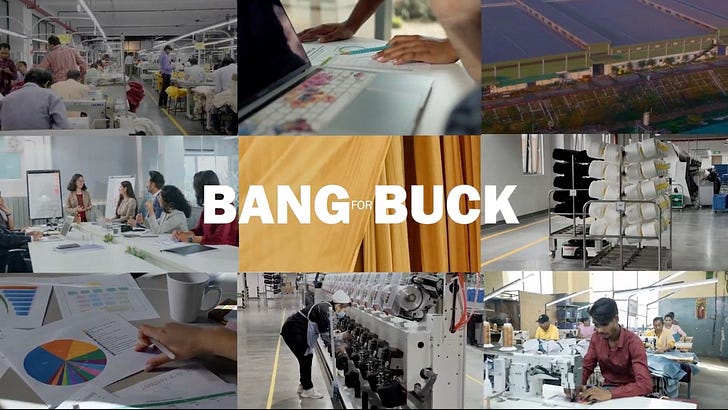
We weren’t wrong. As recently as a few months ago, FPC facilitated a group of manufacturers in creating Bang for Buck, a tool that helps factories assess which interventions in proven emissions-reduction technologies do—and don’t—have an ROI in their context. The idea is to help each facility develop its own hierarchy of interventions, rather than having to implement solutions prescribed by customers that may not deliver the best (or even any) bang for buck.
So no, I don’t think we were wrong. But we were incomplete.
The implicit assumption underpinning all of this is that if there is an ROI, and the capital to finance it is affordable, accessible, and available, the investment will happen.
Now, what I would say if we met over drinks in 2026, is that all of those are necessary, but not sufficient, conditions.
Imagine you’re thinking about buying a house. You’ve found a property that you feel pretty confident will make for a good investment—meaning you believe the money you’re going to put into it today, plus your future mortgage payments, will generate sufficient value in the future to justify the cost, risk, and opportunity cost of committing those resources.
The only problem? You’re not actually very confident about your earning potential, or about your ability to make the mortgage payments.
The result? You probably concluded that buying the house is unwise, no matter how compelling the investment itself might be. And even if somehow you do decide it’s sensible to go ahead, the bank would probably stop you—because you wouldn’t qualify for the mortgage in the first place (unless, of course, you were trying to buy a house in the US in early 2008).
In other words: whether an investment has an ROI is immaterial to a manufacturer if there isn’t confidence in future income, in future business.
Notice that I did not say better forecasts. I said confidence in future business.
Sure, better—meaning more accurate—forecasts are always a good thing. And yes, we can and should try to get better at forecasting. But even if we got a hell of a lot better, forecasts will always be wrong. At the end of the day, none of us in this industry has a crystal ball. We cannot see into the future and perfectly predict consumer demand.
So the question is: when the forecast, inevitably, is wrong, who’s left holding the bag?
If the answer is essentially the manufacturer, then even a very good forecast doesn’t necessarily create confidence. The manufacturer knows that the downside is asymmetric: the brand gets the flexibility; the factory gets the stranded capacity, inventory, or investment.

Notice that I also did not say committed forecasts.
Sure, as factory people, our default reaction to being offered a committed forecast—my former factory manager self included—might be to jump for joy. But it probably wouldn’t take long for that initial dopamine hit to wear off before we started thinking: wait a minute…my customer holding inventory it can’t sell isn’t actually good for me either...
Confidence in future business isn’t really the same as a commitment that, under certain circumstances, someone will buy what we produce—especially if that commitment creates a different kind of risk for the customer that ultimately undermines confidence in future business.
So what does give a manufacturer confidence in future business?
Anecdotally, I think confidence in future business is one of those nebulous terms that can mean a lot of different things and, ultimately, is very relational. Maybe it’s about how long a manufacturer has been working with a particular customer. Maybe it’s about whether that customer is considered a critical part of the manufacturer’s own strategy. Maybe it’s simply that, over time, the manufacturer has seen that when the customer says it expects to do a certain amount of business, it generally does. Maybe it’s that the owners of the respective companies get on well. The list could go on. Then layer the macroeconomic and political context on top of all this, and you end up with something that is much more a matter of judgement than formula.
I don’t want to be reductionist about it. But there are some “hard” mechanisms that would certainly improve confidence in future business.
Prices that hinge on consistency relative to forecast, for example, can help. Not because they make the forecast more accurate, but because they change what happens when the forecast is wrong: the manufacturer won’t disproportionately (relative to margins) be left absorbing the consequences.
Or it might be transparency from brands about whether—and how—sustainability asks will actually be factored into sourcing decisions, including the algorithms behind open bidding platforms. If a manufacturer is being asked to invest in a more efficient machine, better cooling, or some other sustainability intervention, but has no idea whether that investment will actually count when the next sourcing decision is made, it’s hard to see the ask as a signal of future business. If the manufacturer knows that sustainability performance will actually affect how bids are evaluated, the connection between the investment today and the prospect of business tomorrow becomes a little more tangible.
Deposits would help too—but only if they’re structured around the total supply-chain lead time, rather than just the lead time of the final manufacturer. If a manufacturer is being asked to commit capacity, procure materials, or make other investments well in advance of production, a deposit that only reflects the value of the final purchase order may not provide much confidence. The question is whether the deposit is large enough—and comes early enough—to signal that the customer is sharing some of the risk of making those commitments.
The list could, presumably, go on. But it’s past midnight, and I need to start wrapping this up.
Before I do, though, for the numerately inclined (of which I do not count myself one, so bear with me), here’s the math version of this essay:
Let’s say a factory produces 100 units and has $540 in direct and indirect production costs to recover. That’s $5.40 per unit of production, against a $6 FOB selling price (Note: even a 10% margin is a generous estimate in a sector where, at least in my experience, manufacturers’ margins tend to be in the single digits.)
Now imagine the factory’s workforce becomes 10% more efficient; it can produce the same 100 units with 10% less productive labor.
If there’s no additional demand, however, those hours don’t disappear (at least in the short term). They simply become idle. The factory is more efficient, but it still has to pay for the same labor, and its other costs haven’t changed. So it still has $540 in costs to recover across 100 units: $5.40 per unit.
Now imagine there is enough demand to use the capacity created by that efficiency improvement. The factory can produce more with essentially the same cost base. That’s certainly better for the factory’s bottom line. But even then, the efficiency improvement is only affecting the direct-labor portion of the cost.
Let’s say direct labor accounts for $140 of the factory’s $540 total cost. If the efficiency gain can actually be converted into a 10% reduction in direct-labor cost and all other costs remain the same (which in the short term is a reasonable assumption), that saves $14. So even a 10% improvement in direct-labor efficiency would reduce the factory’s total costs by only about 2.6%. We can and should debate the proportions in this hypothetical, but let’s not let that distract us from the main point: even a meaningful improvement in one cost category can have a relatively modest impact on the factory’s cost per piece sold.
Now look at what happens when demand moves in the other direction.
If demand falls by 10%, the factory produces 90 units instead of 100. But it still has $540 in costs to recover.
$540 ÷ 90 = $6.00 per unit.
And remember, the factory was selling those units for $6 FOB. At 100 units, it had a $0.60 margin per unit. At 90 units, that margin has disappeared entirely: the factory is now producing each unit for roughly what it can sell it for.
So a 10% drop in demand increases the cost per unit sold from $5.40 to $6.00, wiping out the factory’s entire margin. By contrast, a 10% improvement in direct-labor efficiency—even if it can actually be converted into a cost saving—only reduces total costs by about 2.6%. These figures should be held lightly, and are used for illustrative purposes, but the larger point I’m trying to make is this: unanticipated fluctuations in demand matter far more for cost management than incremental efficiency gains.
And the asymmetry is important. A 10% change in demand can happen quickly; a 10% productivity improvement is much harder to achieve, requiring sustained investment, process changes, learning and, often, significant time. The factory can therefore spend years chasing incremental productivity gains, only for a relatively modest demand shock to erase its margin almost overnight. For the manufacturer, that can mean going from profit to loss with very little warning.
Meanwhile, a 10% change in demand does not impose a 10% change in costs on the brand. The materials, factory capacity, and labour required to produce its goods largely sit outside the brand’s own balance sheet. The cost of maintaining that capacity—and, crucially, the cost of leaving it idle when demand falls—is borne elsewhere in the value chain.
One of the few coping mechanisms available to a manufacturer in this context—and key to its economic survival—is therefore flexibility: eliminating the risk of idle resources, whether people, capacity or materials. Cue the short-term contracts, piece rates, and stories of workers not stopping for water and bathroom breaks.
And yet this underlying dynamic is barely acknowledged in the sustainability conversation. Purchasing practices get at the issue, but only peripherally: frameworks on responsible purchasing rightly identify things like forecasting, order stability, lead times, costing and payment terms as practices that can shift risk onto suppliers and workers. But these are, in turn, symptoms of a bigger picture: the way demand risk is distributed across the value chain. When manufacturers operate on thin margins and carry largely fixed costs, they have a strong incentive to make their labour and material inputs as variable as possible—and to further offload the consequences of demand volatility.
At most, the sustainability conversation tends to make vague calls for “shared responsibility” across the value chain. But that leaves the more fundamental question largely untouched: if the risks are not actually shared, but systematically pushed towards the least powerful actors in the chain, what does “shared responsibility” really mean?
But I’m getting ahead of myself. What does all of this have to do with ROI, and what drives a manufacturer’s willingness to invest?
Well, when we think about ROI, we assume that the investment will pay itself back through some reduction in operating costs. In the case of heat stress, that may be less about making people more productive and more about maintaining current productivity as temperatures rise (which, it should be noted, will still lead to a net negative effect on a factory’s margins relative to the assumptions used for costing and as the basis for price negotiations with brands). But there’s no point in even beginning to try to quantify those gains, and their impact on ROI calculations, if we don’t have confidence in future business. Because, as the math shows, a relatively small change in demand can have a much bigger impact on the economics of a factory than incremental cost reductions—or, for that matter, even incremental cost increases.
Now it’s nearing 1 AM and, for both our sakes, I really must wrap this up. I began with a promise of musings about the lessons from decarbonization for driving investment in heat stress. Well, in short, I think one of the lessons is that, yes, the economic case matters, and the economic case will be contextual, which means that prescribing blanket, one-size-fits-all interventions for factories should be a non-starter. We also learned that in addition to needing an ROI, the capital must also be available and accessible. But the other lesson—and one that I don’t yet hear talked about very often—is that all the discussion of incremental efficiency gains, ROI, and financing is moot if there isn’t confidence in future business.
My wish for heat stress is this: we must seek more than a single story. We must seek to understand, in all its messy glory, the multitude of factors that shape a factory’s decision to invest or not invest in something. Let’s drop the reductionist assumption that if a brand says jump, the factory will jump. Let’s drop the reductionist assumption that an ROI is all it takes. Indeed, we can pass laws, we can require targets, we can mandate prescriptive protocols that are not relevant to local context but nonetheless enable a brand to meet its compliance requirements, we can require brands to require manufacturers to do all kinds of things. But none of these things got us anywhere near close to achieving our collective decarbonization ambitions. What makes us think the same approach will play out differently when it comes to heat stress? This, in our context, is the danger of a single story.

Would you like to be involved with the FPC?
This platform is for producers. Whether you’re interested in potentially opting-in to our activities, or generally see value in these activities and want to support them, we’d love to talk. Contact us by email team@fashionproducercollective.org.
Thoughtful and wise. Once more. And, yes. if a decision to invest is to maintain the status quo and not absorb a productivity loss...the case is sane but hard. Additionally, investment choices are not made discretely...they are a choice amongst many different options. Said differently, investments in sustainability must rise above competing investments in growth or capability or cost reduction in order to get funded.