



Bang for Buck will launch on 29 April. Register for our upcoming Bang for Buck webinar sessions on the 12 & 13 of May, which will cover an introduction to the framework, a look at the tool in action across the fashion supply chain, and a deeper technical walkthrough.
Last week, we argued that the industry doesn’t lack solutions — it lacks alignment on how to prioritize between them.
This week, let’s take that one step further:
There is no universal decarbonization roadmap.
And pretending there is may be one of the biggest barriers to scaling progress.
Hyper-Local Reality
Manufacturing decarbonization outcomes - whether in terms of impact of financial - are highly sensitive to local conditions, including:
Energy prices
Grid infrastructure
Regulatory and tariff structures
Engineering capabilities
Operating hours
Financing environment
Internal management buy-in
Two factories producing similar products down the road from one another can have radically different feasibility profiles for the exact same intervention. The economics are hyper-local.
A Simple Illustration: Rooftop Solar
Take a commonly recommended intervention: rooftop solar.
In one geography, it may deliver a three-year payback.
In another, it may require:
Structural roof reinforcement
Transformer upgrades
Imported components subject to duties
Nonexistent net metering
Long-term power purchase agreements with restrictive termination clauses
The same intervention can swing from financially compelling to commercially unrealistic depending on context.
There are no pre-defined paybacks.
Yet many programs assume there are.
Why Prescriptive Pathways Stall
When universal decarbonization pathways are prescribed:
They often clash with local financial feasibility
Manufacturers push back
Scaling slows
Trust erodes
When multiple brands prescribe different strategies to the same supplier, the complexity multiplies. Manufacturers are left juggling competing timelines, preferred technologies, and reporting requirements — all funded from the same capital pool.
This fragmentation doesn’t accelerate decarbonization.
It diffuses it.
From Intervention Lists to Investment Pipelines
If there is no universal roadmap, what replaces it?
A structured decision strategy.
The starting point is not a short list of favored interventions. It’s a comprehensive opportunity list at the facility level.
From there:
Quantify carbon reduction potential
Estimate capital costs
Calculate savings
Rank interventions
This is where marginal abatement cost becomes powerful.
A Marginal Abatement Cost Curve ranks interventions by cost per ton of CO₂ reduced.
Some interventions generate both carbon reduction and positive financial returns.
Others reduce emissions at a cost.
Some deliver minimal impact for significant capital outlay.
When combined with payback and ROI thresholds, this allows facilities to build investment pipelines that reflect real-world constraints.
Not theoretical pathways.
What’s Launching Next Week
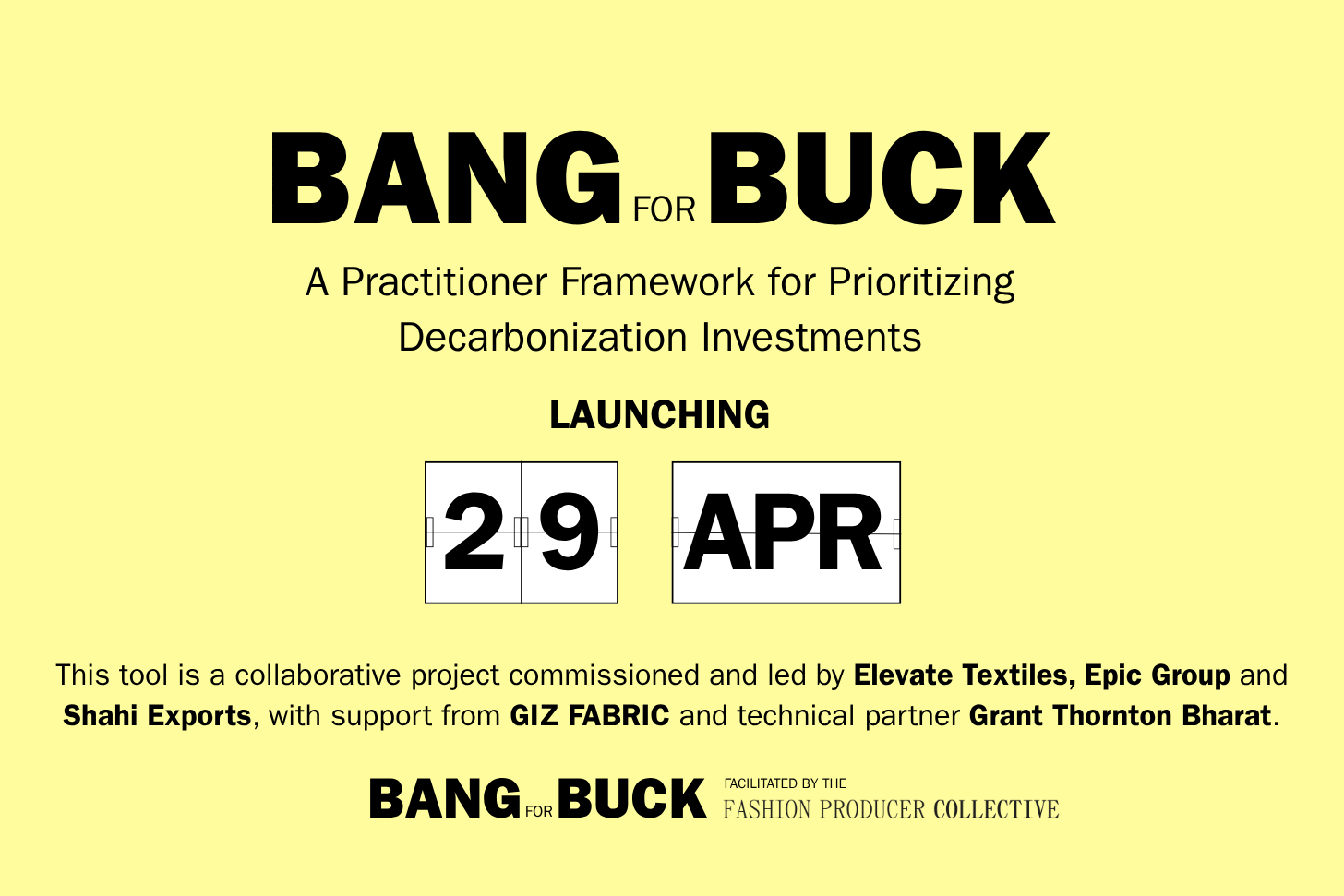
Next week, we introduce Bang for Buck — a producer-led prioritization framework built within the Fashion Producer Collective.
It was designed by producers, for producers, to help facilities:
Build site-specific intervention hierarchies
Quantify financial and carbon trade-offs
Prioritize based on ROI, payback, or marginal abatement cost
Construct actionable investment roadmaps
It doesn’t prescribe solutions.
It standardizes how to evaluate them.

If you haven’t registered for the launch sessions yet, now is the time.
This tool is a collaborative project commissioned and led by Elevate Textiles, Epic Group and Shahi Exports, with support from GIZ FABRIC and technical partner Grant Thornton Bharat. Bang for Buck is facilitated by the Fashion Producer Collective.
Thanks for creating this! It’s a great tool for the industry.